
Marintec Innovation 2026 to Chart Maritime's Energy Transition
Press Release14 September 2026
Two-Day Conference Unites Global Industry Leaders to Address Decarbonisation Through AI Collaboration, Flexible Ship Design, and Nuclear Propulsion
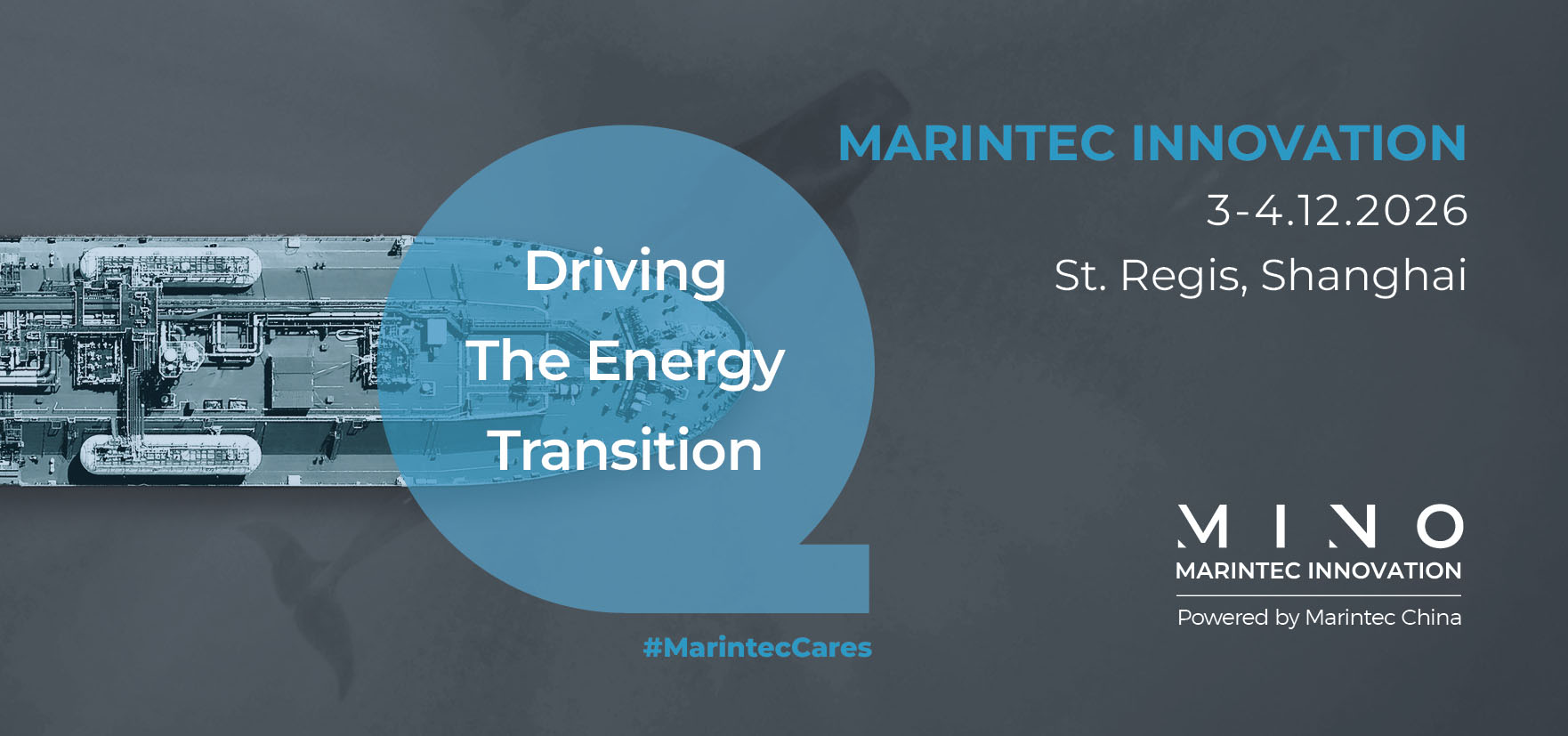
HONG KONG, 24 September 2026 – The Organising Committee of Marintec Innovation 2026 announces a landmark conference convening maritime industry leaders, technology innovators, and policy makers at the St. Regis Shanghai on 3–4 December 2026. This essential gathering addresses the most pressing challenge facing global shipping: achieving net-zero emissions whilst maintaining the operational and economic viability of an industry that moves over 80% of world trade.
Organised by Informa Markets in partnership with the Shanghai Society of Naval Architects and Marine Engineers (SSNAME), Marintec Innovation 2026 adopts a unique "Three Horizons" framework, examining solutions across immediate, mid-term, and long-term timeframes. From AI-driven operational efficiency today, through modular ship platforms for tomorrow's uncertain fuel landscape, to nuclear-powered fleets as the ultimate decarbonisation solution, the conference provides a comprehensive roadmap for maritime's energy transition.
Navigating Uncertainty with Strategic Clarity
The maritime industry faces unprecedented complexity in its decarbonisation journey. Shipowners are investing billions in vessels with 20- to 30-year lifespans, yet the optimal fuel mix remains uncertain. Marintec Innovation 2026 provides a strategic framework for making sound decisions amid uncertainty, bringing together the collective wisdom of the industry's most forward-thinking organisations.
The conference's three-horizon approach acknowledges that different solutions operate on different timescales. Short-term gains through digitalisation and AI reduce emissions immediately. Mid-term flexible architectures hedge against fuel uncertainty. Long-term nuclear propulsion offers a pathway to true zero-emission deep-sea shipping. Rather than presenting these as competing alternatives, Marintec Innovation 2026 explores how they form an integrated transition strategy that delegates can implement within their own organisations.
The Fifth Industrial Revolution: Humans and AI in Cooperation
The conference's short-term focus examines how the Fifth Industrial Revolution, characterised by human-AI collaboration rather than automation alone, is delivering measurable efficiency gains across the maritime sector. Unlike previous industrial revolutions that replaced human labour, 5IR positions artificial intelligence as a collaborative partner to crews, engineers, and managers.
Delegates will discover how digital twins, autonomous systems, and AI-powered optimisation are reducing fuel consumption and emissions today whilst building the digital foundation for advanced ship design and 3D engineering capabilities. This is operational reality being implemented by leading shipowners and operators worldwide.
A highlight of this session features a cross-industry case study from aviation, where AI is pioneering the new field of Computational Engineering Models (CEM), in which complex technical objects are created using computer code rather than traditional design methods. This example demonstrates what maritime can achieve when human expertise and machine intelligence truly converge, transforming 3D work from design to engineering and freeing human engineers to focus on innovation, strategic decisions, and creative problem-solving.
Designing for Tomorrow: Flexible Ship Architectures
The mid-term horizon addresses the industry's most vexing challenge: designing and building ships today that can adapt to multiple energy carriers over their operational lifetime. With battery electric, hybrid, methanol, ammonia, and other alternatives competing for dominance, shipowners need vessels that can pivot as the fuel landscape evolves, without requiring prohibitively expensive retrofits or premature scrapping.
This session places vessel architecture and design philosophy at its core. Delegates will explore how modular ship platforms can accommodate different propulsion systems, fuel storage configurations, and power generation equipment throughout a vessel's service life. The discussion examines advanced manufacturing techniques that enable rapid production of bespoke components for fuel system conversions and upgrades.
Crucially, the session recognises that innovation and regulation must advance in lockstep. Classification societies play an indispensable role in this transition, future ship design needs to walk with both legs together to move forward: one leg representing technological innovation and design flexibility, the other representing the regulatory frameworks and safety standards that classification societies develop and enforce. Distinguished panellists will examine how shipyards, equipment manufacturers, classification societies, and technology providers are collaborating to create vessels with "future-proof" designs.
The infrastructure ecosystem supporting flexible ship design receives equal attention. Floating charging networks that can reposition based on trade routes, multi-fuel bunkering facilities capable of supplying various alternative fuels, and port infrastructure designed for adaptability rather than single-fuel optimisation all form part of the flexible architecture paradigm that delegates will explore in depth.
The discussion acknowledges that no single solution will dominate, success requires vessels and infrastructure capable of adapting to regional fuel availability, regulatory requirements, and economic conditions as they evolve over decades. Delegates will leave with actionable strategies for building flexibility into their fleet planning and investment decisions, understanding the balance between the premium for adaptability and the risk of technological lock-in.
The Nuclear Frontier: Achieving True Net Zero
For deep-sea shipping, nuclear energy is moving from theoretical possibility to tangible reality. The long-term horizon session examines the practical pathway ahead: from research and demonstration plants to supply chain development, fuel fabrication, port infrastructure, regulatory frameworks, and crew training standards.
Nuclear propulsion is engineering, not science fiction. The question is not whether it is technically feasible, but how the industry builds the commercial, regulatory, and operational ecosystem to make it viable at scale. The session features perspectives from industry leaders addressing the technical, commercial, and regulatory pathways to making nuclear propulsion a commercial reality.
A critical focus is the role of advanced AI-driven automation, remote monitoring, and robotics in ensuring safety throughout nuclear vessel operations, enabling continuous oversight and rapid response whilst minimising human exposure to operational risks.
Equally important is the comprehensive ecosystem development required to support commercial nuclear shipping. Regulatory frameworks must be established internationally with harmonised standards. Classification societies are actively developing new rules and certification processes for nuclear-powered merchant vessels. Supply chain infrastructure including fuel fabrication facilities, specialised maintenance capabilities, and port adaptations. Maritime academies must develop curricula for nuclear-qualified seafarers and engineers. All must be developed at scale.
The session examines how these parallel workstreams must progress simultaneously to enable commercial nuclear shipping, providing the foundation for achieving true net-zero deep-sea shipping aligned with 2050 decarbonisation goals.
From Discussion to Action: A Working Session
Unlike traditional conferences that conclude with summary remarks, Marintec Innovation 2026 ends with a working session designed to convert insights into measurable, time-bound commitments. The closing panel synthesises perspectives from all three horizons, identifies critical gaps, regulatory, financial, infrastructural, and human capital, and defines concrete next steps, collaborative initiatives, and accountability mechanisms.
This is about catalysing action, not generating more discussion. Delegates will participate in defining the industry's path forward, working alongside the decision-makers who can move the needle on maritime decarbonisation.
Looking Ahead: The Human Element
A special teaser offers delegates a glimpse of Marintec China 2027, which will introduce a new focus area: Seafarer Wellness & The Human Element. This addition acknowledges a fundamental truth, no matter what future energy sources power vessels, how advanced AI systems become, or how radically ship design evolves, seafarers remain at the heart of maritime operations.
As the industry navigates technological transformation, the human element cannot be an afterthought but must be a central pillar of every innovation strategy. Marintec China 2027 will explore seafarer wellness, mental health, training for new technologies, crew adaptation to autonomous systems, and creating sustainable careers at sea. Ultimately, all plans for the future of shipping must prioritise the people who make it possible.
After all, human first.
Secure Your Place at This Essential Industry Gathering
Marintec Innovation 2026 takes place 3–4 December 2026 at the St. Regis Shanghai. The conference brings together leading organisations including ABB, Alfa Laval, Berg Propulsion, Bureau Veritas, China Classification Society, Copersucar, DNV, The International Bunkers Industry Association, The International Windships Association, The Maritime Ethanol & Methanol Alliance, The Maritime Battery Forum, Kongsberg Digital, RINA Italy, Shanghai Jiao Tong University, Jiangnan Shipyard, Ulstein, Wikborg Rein and many others representing the full spectrum of maritime innovation.
This is a unique opportunity for maritime professionals to engage directly with the technologies, strategies, and partnerships that will define the industry's future. Delegates will gain actionable insights, forge valuable connections, and contribute to shaping the roadmap for maritime decarbonisation.
Detailed programme information and confirmed speaker line-up will be available by the end of October 2026.
For registration information and updates, visit www.marintecchina.com or contact [email protected]
Organisers:
Marintec China is organised and managed by Informa Markets and Shanghai Society of Naval Architects & Marine Engineers (SSNAME).
Informa Markets
Informa Markets creates platforms for industries and specialist markets to trade, innovate and grow. Our portfolio is comprised of more than 550 international B2B events and brands in markets including Healthcare & Pharmaceuticals, Infrastructure, Construction & Real Estate, Fashion & Apparel, Hospitality, Food & Beverage, and Health & Nutrition, among others. We provide customers and partners around the globe with opportunities to engage, experience and do business through face-to-face exhibitions, specialist digital content and actionable data solutions. As the world’s leading exhibitions organiser, we bring a diverse range of specialist markets to life, unlocking opportunities and helping them to thrive 365 days of the year. For more information, please visit www.informamarkets.com.
Shanghai Society of Naval Architects and Marine Engineers (SSNAME)
Shanghai Society of Naval Architecture and Marine Engineers (SSNAME), founded in early 1951, is the first scientific and technological society in the field of shipbuilding and marine engineering of the People’s Republic of China. SSNAME currently has 5,000 individual members and more than 60 group members. It has 5 working Committees, 11 Specialized Committees and 3 Representative offices. As an important non-governmental scientific and technological society with high reputation and influence in the international field of shipbuilding and marine engineering, SSNAME has been committed to promoting the progress of shipbuilding and marine engineering technology and international exchanges and cooperation. SSNAME has established closely cooperative relations with 14 well-known overseas maritime engineering societies, such as SNAME, RINA, STG, JSNAOE, SNAK and so on. It is the initiator and first chairman of the Pan-Asian Association of Maritime Engineering Societies (PAAMES) and is also a member of the International Standing Committee of the World Maritime Technology Conference (WMTC). The "Xin Yixin Ship and Marine Engineering Science and Technology Innovation Award" founded by SSNAME has become an important award for scientific and technological talents. SSNAME organizes many academic exchanges, popular science and scientific and technological publication every year. For more information, please visit www.ssname.com.cn.