
MARINTEC INNOVATION 2026
Driving the Energy Transition
3-4 . 12 . 2026 | St. Regis Shanghai
MARINTEC INNOVATION 2026: DRIVING THE ENERGY TRANSITION
Marintec Innovation 2026 is a landmark two-day conference convening global maritime leaders, technology innovators, and policy makers at the St. Regis Shanghai on 3–4 December 2026. The conference addresses the maritime industry's most pressing challenge: achieving net-zero emissions whilst maintaining operational and economic viability.
Unlike traditional conferences, Marintec Innovation is about catalysing action, not generating more discussion. Delegates will engage directly with leading organisations including ABB, Alfa Laval, Berg Propulsion, Bureau Veritas, China Classification Society, Copersucar, DNV, The International Bunkers Industry Association, The International Windship Association, Jiangnan Shipyard, Kongsberg Digital, The Maritime Battery Forum, The Maritime Ethanol & Methanol Alliance, Panama's Maritime Authority, RINA Italy, Shanghai Jiao Tong University, Ulstein, Wikborg Rein, and many others representing the full spectrum of maritime innovation, gaining actionable strategies, forging valuable connections, and contributing to shaping the industry's decarbonisation roadmap.
Keynote Address | Setting the Scene: Navigating the Three Horizons
3 December 2026, Thursday, Morning Session
The maritime industry stands at a crossroads. With over 80% of world trade moving by sea, achieving net-zero emissions whilst maintaining operational and economic viability represents the sector's greatest challenge. This opening session establishes the strategic framework for Marintec Innovation 2026, introducing the "Three Horizons" approach that examines solutions across immediate, mid-term, and long-term timeframes. Industry leaders will outline the complexity facing shipowners investing billions in vessels with 20- to 30-year lifespans amid fuel uncertainty, regulatory evolution, and technological disruption. Rather than presenting competing alternatives, this session positions digitalisation, flexible architectures, and nuclear propulsion as an integrated transition strategy. Delegates will gain strategic clarity on how to make sound decisions amid unprecedented uncertainty, setting the stage for two days of actionable insights and collaborative problem-solving.
Session 1 | The Fifth Industrial Revolution - Human and AI in Cooperation
3 December 2026, Thursday, Afternoon Session
The Fifth Industrial Revolution is here, and it's not about replacing humans, but empowering them. This session explores how human-AI collaboration is delivering measurable efficiency gains across maritime operations today. Unlike previous industrial revolutions that automated labour, 5IR positions artificial intelligence as a collaborative partner to crews, engineers, and managers. Delegates will discover how digital twins, autonomous systems, and AI-powered optimisation are reducing fuel consumption and emissions immediately whilst building the digital foundation for advanced ship design and 3D engineering capabilities. A highlight features a cross-industry case study from aviation pioneering Computational Engineering Models (CEM), where complex technical objects are created using computer code rather than traditional design methods, demonstrating what maritime can achieve when human expertise and machine intelligence truly converge. This is operational reality being implemented by leading shipowners worldwide, freeing human engineers to focus on innovation, strategic decisions, and creative problem-solving.
Session 2 | Designing for Tomorrow: Flexible Ship Architectures
4 December 2026, Thursday, Morning Session
How do you design a ship today that can adapt to multiple energy carriers over a 20- to 30-year operational lifetime? This session addresses the industry's most vexing challenge: creating vessels that can pivot as the fuel landscape evolves, without prohibitively expensive retrofits or premature scrapping. With battery electric, hybrid, methanol, ammonia, and other alternatives competing for dominance, shipowners need modular ship platforms that accommodate different propulsion systems, fuel storage configurations, and power generation equipment throughout a vessel's service life. Distinguished panellists including shipyards, equipment manufacturers, classification societies, and technology providers, examine how innovation and regulation must advance in lockstep. The discussion explores advanced manufacturing techniques enabling rapid production of bespoke components for fuel system conversions, and the critical infrastructure ecosystem, and adaptable port infrastructure. Delegates will leave with actionable strategies for building flexibility into fleet planning and investment decisions, understanding the balance between the premium for adaptability and the risk of technological lock-in.
Session 3 | Achieving Net Zero: The Nuclear Frontier
4 December 2026, Thursday, Afternoon Session
Nuclear propulsion for commercial shipping is moving from theoretical possibility to tangible reality. This session examines the practical pathway ahead: from research and demonstration plants to supply chain development, fuel fabrication, port infrastructure, regulatory frameworks, and crew training standards. The question is not whether nuclear propulsion is technically feasible, it's engineering, not science fiction. But how the industry builds the commercial, regulatory, and operational ecosystem to make it viable at scale. Industry leaders address the role of advanced AI-driven automation, remote monitoring, and robotics in ensuring safety throughout nuclear vessel operations. Equally critical is comprehensive ecosystem development: internationally harmonised regulatory frameworks, classification society rules and certification processes for nuclear-powered merchant vessels, maritime academy curricula for nuclear-qualified seafarers, and supply chain infrastructure including fuel fabrication facilities and specialised maintenance capabilities. This session provides the foundation for understanding how parallel workstreams must progress simultaneously to enable commercial nuclear shipping and achieve true net-zero deep-sea shipping aligned with 2050 decarbonisation goals.
Closing Remarks | Marintec Exchange: From Insights to Action
4 December 2026, Thursday, Afternoon Session
Marintec Innovation 2026 ends with a working session designed to convert insights into measurable, time-bound commitments. This closing panel synthesises perspectives from all three horizons, identifies critical gaps, regulatory, financial, infrastructural, and human capital; Defines concrete next steps, collaborative initiatives, and accountability mechanisms. This is about catalysing action, not generating more discussion. Delegates will participate in defining the industry's path forward, working alongside the decision-makers who can move the needle on maritime decarbonisation. The session establishes clear accountability frameworks and collaborative partnerships that extend beyond the conference, ensuring that the strategic clarity gained over two days translates into tangible progress toward net-zero shipping. Delegates leave not just informed, but equipped and committed to driving change within their organisations and across the industry.

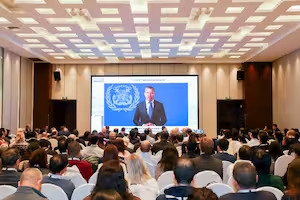
MINO 2024: A MILESTONE IN MARITIME SUSTAINABILITY
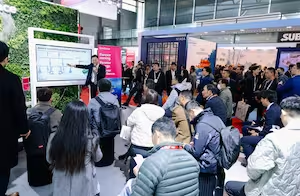
Marintec Innovation 2024 was a landmark event, underscoring the maritime industry’s commitment to sustainability. Hosted in Shanghai, the conference highlighted the urgent need to transition from high-carbon operations to low-carbon and ultimately zero-carbon solutions.
- 500+ Distinguished Speakers and Delegates: Senior leaders and experts shared transformative strategies to drive sustainable practices.
- 20,000+ Engaged Viewers: The Marintec WeChat Mini Program attracted significant attention, reflecting the industry’s growing focus on decarbonisation.

MINO 2025: INTRODUCING ENERGYTEC
Marintec Innovation 2025 introduced the groundbreaking “Energytec” initiative, focusing on alternative energy sources and the maritime industry chain. This programme invited global enterprises to collaborate and accelerate the decarbonisation of maritime operations.
Key highlights included five themed sessions:
- Keynote Address: Strategic insights into alternative energy solutions.
- Alternative Fuels: Exploring cleaner and more sustainable fuel options.
- Electrification: Advancing electric propulsion technologies.
- Natural Sources: Harnessing wind and wave energy for maritime applications.
- Nuclear Power: Investigating the potential of small modular reactors (SMRs) for the sector.

LOOKING AHEAD
Marintec Innovation 2026 is poised to serve as the global epicentre for alternative energy in maritime, reinforcing the industry’s commitment to clean energy and sustainable operations. Hosted in Shanghai, a city renowned for its world-class infrastructure, this flagship event will deliver actionable insights, foster strategic partnerships, and provide a clear vision for the maritime energy transition.
Post-event activities will include the publication of white papers, follow-up webinars, and the formation of working groups to implement the strategies discussed during the conference.
Senior leaders are invited to join this transformative journey, driving green development and decarbonisation across the maritime industry. Together, we can shape a sustainable future and redefine the global maritime landscape.
Join us in our mission to drive green development and decarbonisation in the maritime industry. Together, we can chart a course towards a sustainable future.
For more information, please email to [email protected].